

If you’ve spent any time researching non-surgical ways to fix sagging cheeks, hollow temples, or deep smile lines, you’ve probably run into two names over and over: Sculptra and dermal fillers. Both get injected into your face. Both are used to fight the visible signs of aging. And both get lumped together as if they do the same thing, when in reality, they work in completely different ways.
In the debate over Sculptra vs dermal fillers, the real question isn’t which one is “better.” It’s which approach matches what your skin actually needs. Sculptra is a collagen stimulator that rebuilds your skin’s own structure gradually, while dermal fillers are hyaluronic acid gels that add volume the moment they’re injected. One works with your biology over months; the other gives you an instant physical change.
Sculptra vs Dermal Fillers
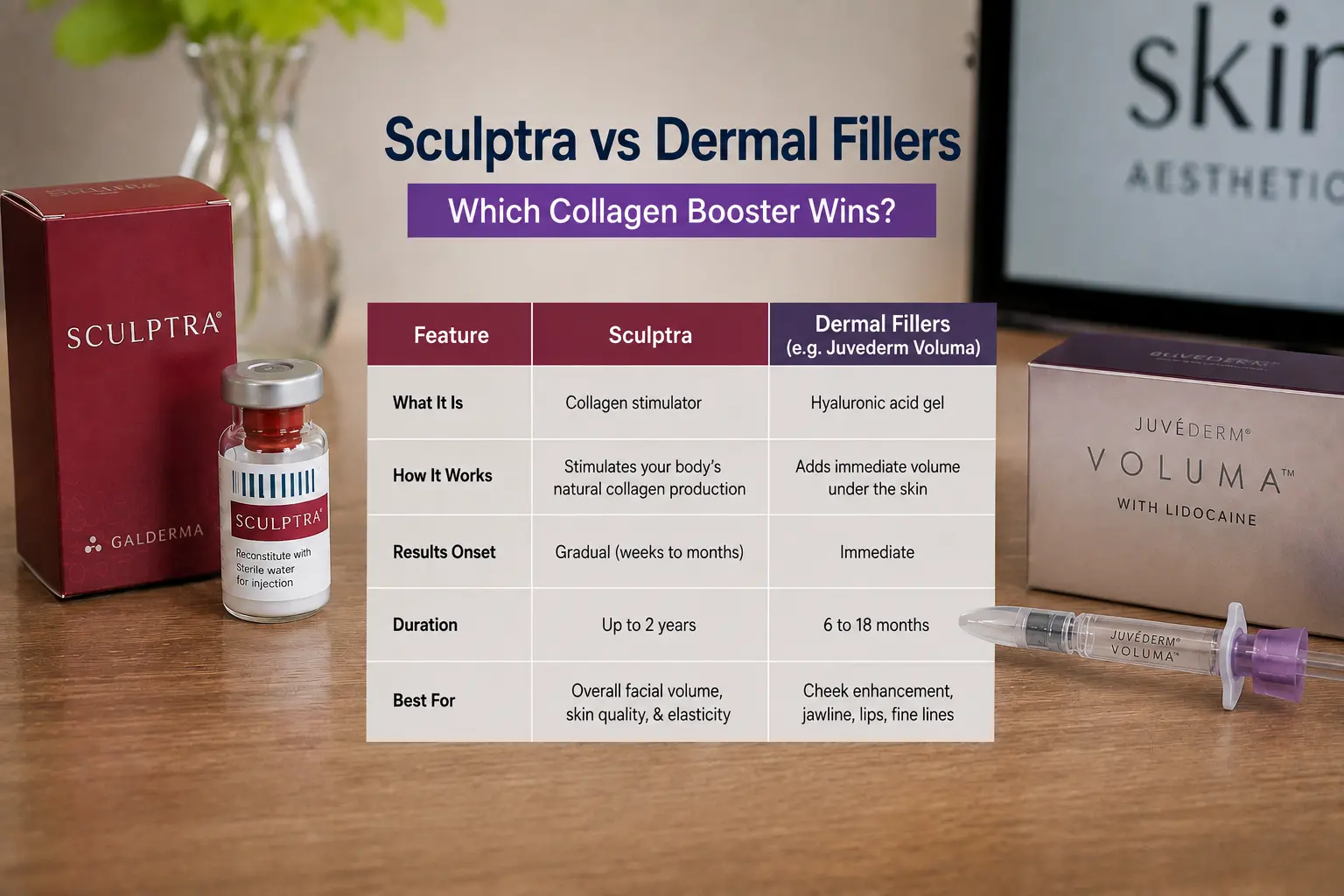
Sculptra is a collagen-stimulating injectable made from poly-L-lactic acid that gradually rebuilds your skin’s own collagen over several months and lasts up to two years or longer. Dermal fillers are hyaluronic acid gels that add instant volume to a specific area and typically last six to eighteen months. Sculptra suits broad facial thinning and long-term collagen renewal, while dermal fillers suit precise, immediate volume in areas like the lips or under-eyes.
| Sculptra | Dermal Fillers | |
|---|---|---|
| Main ingredient | Poly-L-lactic acid (PLLA) | Hyaluronic acid (HA) |
| How it works | Stimulates your own collagen production | Physically adds volume under the skin |
| When results appear | Gradually, over 4 to 6 weeks | Immediately |
| How long results last | Up to 2 years or longer | 6 to 18 months |
| Number of sessions | 2 to 3, spaced weeks apart | Usually 1 per area |
| Can it be dissolved | No | Yes, with hyaluronidase |
| Best for | Broad facial volume loss, overall thinning | Precise areas like lips, under-eyes, cheeks |
What Is the Difference Between Sculptra and Dermal Fillers?
What Is Sculptra?
Sculptra is a type of collagen stimulator, sometimes called a biostimulator, made from poly-L-lactic acid (PLLA). This is a biodegradable, biocompatible material that has been used safely in medicine for decades, including in dissolvable stitches. Instead of physically sitting under your skin and pushing it up like a cushion, PLLA works more like a signal. Once injected, it encourages your skin’s fibroblasts to start producing new collagen and elastin on their own. You can read more about how this process fits into an overall skin care treatment plan.
Think of Sculptra less like “filling a pothole”. It doesn’t happen overnight, but the structure ends up stronger.
What Are Dermal Fillers?
Dermal fillers, in most cases, are made from hyaluronic acid (HA), a substance your skin already produces naturally to stay hydrated and plump. Brands like Juvederm and Restylane fall into this category. When injected, HA fillers physically occupy space under the skin, smoothing lines and restoring lost volume in areas like the cheeks, lips, or jawline right away. Dermal fillers are the “pothole” approach. You fill the gap directly, and you see the change the same day you leave the clinic.
So the core difference comes down to this: one treatment stimulates your body to rebuild collagen, and the other adds volume from the outside. Everything else, from timeline to longevity to how each one feels, flows from that one basic distinction.
How Does Sculptra Work Compared to Dermal Fillers?
The main difference is timing: dermal fillers add volume the moment they’re injected, while Sculptra takes weeks to build results because it works by stimulating your own collagen rather than sitting under the skin as filler.
Dermal fillers are gel-based, so the moment they’re injected, they add physical volume. There’s no waiting for biology to catch up. What you see minutes after your appointment is close to your final result, once any swelling settles down over a few days.
Sculptra doesn’t offer that same instant payoff. The PLLA particles are diluted in liquid and injected into the deeper layers of skin. Over the following weeks, your body gradually absorbs the liquid carrier while fibroblasts get to work laying down new type I and type III collagen. This means the plumping you notice on day one is mostly just fluid. Your face may even look slightly deflated for a week or two before the real results, the ones from your own rebuilt collagen, start appearing around weeks four to six.
Results Timeline: Instant Change vs. A Gradual Build
- Dermal fillers show visible results immediately, with final settling within one to two weeks as swelling resolves.
- Sculptra shows subtle short-term plumping that fades within days, followed by a gradual buildup of collagen that becomes noticeable at four to six weeks and reaches its full effect around three to six months after the last session.
If you need to look your best for an event happening soon, dermal fillers are the more dependable choice. If you’re planning several months and want a change that looks like it happened naturally, Sculptra’s collagen-building process is built for that kind of timeline.
How Long Do Sculptra and Dermal Fillers Last?
Sculptra typically lasts up to two years or longer, while most dermal fillers last six to eighteen months, making Sculptra the longer-lasting option of the two.
Dermal fillers typically last anywhere from six to eighteen months, depending on the product used, the area treated, and how quickly your body metabolizes hyaluronic acid. Areas with more movement, like the lips, tend to break down filler faster than more static areas like the cheeks.
Sculptra results, because they come from your own newly built collagen rather than an injected substance sitting under the skin, can last up to two years or longer. Some long-term studies have shown people still noticing meaningful improvement well beyond the one-year mark.
That longevity is exactly why Sculptra is often described as a collagen booster rather than a filler. It isn’t filling anything at all. It’s restoring the skin’s underlying support structure so it holds its shape on its own.
How Many Sessions Does Sculptra Need vs. Dermal Fillers?
Dermal fillers usually need just one session per treated area, while Sculptra is done as a series of two to three sessions spaced four to six weeks apart to reach full correction.
Here’s a detail people often overlook when weighing these two options: dermal fillers are usually a single appointment per treated area. You walk in, get injected, and walk out with your result already visible.
Sculptra, on the other hand, is designed as a series of treatments. Most providers recommend two to three sessions spaced about four to six weeks apart to reach full correction. Each session is intentionally conservative, since the goal is to build gradually rather than overcorrect in one visit. Skipping sessions or expecting one treatment to do the job of three is one of the most common reasons people feel underwhelmed by their results. A consultation with our specialists can help map out how many sessions your skin is likely to need.
What Are the Side Effects of Sculptra vs Dermal Fillers?
Both treatments cause temporary swelling, bruising, and redness, but Sculptra carries an additional risk of small nodules under the skin. Unlike dermal fillers, it cannot be dissolved if a problem occurs.
Both treatments are non-surgical with fairly minimal downtime, but they’re not identical here either.
Dermal fillers commonly cause mild swelling, bruising, redness, or tenderness at the injection site, usually resolving within three to seven days. Because HA fillers can be dissolved with an enzyme called hyaluronidase, they’re considered more correctable if you’re unhappy with the outcome or if a complication comes up.
Sculptra side effects look similar at first, including swelling, redness, and bruising, but it also carries a specific risk that fillers don’t: subcutaneous nodules. These are small, often invisible bumps under the skin that appear in a small percentage of patients and usually resolve on their own or with massage. Visible granulomas, which are firmer and more noticeable lumps, are rarer, but they’re harder to treat and may need corticosteroid injections to resolve. Following your provider’s aftercare instructions, often called the “5-5-5 rule” (massaging the treated area for five minutes, five times a day, for five days), significantly lowers this risk.
One more important distinction worth knowing before you decide: Sculptra cannot be dissolved. Once it starts stimulating collagen, there’s no quick reversal the way there is with HA fillers. This makes choosing an experienced, board-certified injector even more important with Sculptra than with standard filler treatments. Our aftercare guide has more detail on minimizing swelling and bruising after either treatment.
Which Facial Areas Suit Sculptra vs Dermal Fillers?
Dermal fillers work best for precise areas like the lips and under-eyes, while Sculptra works best for broader areas of volume loss like the cheeks and temples.
Dermal fillers shine in precision work: lips, under-eye hollows, nasolabial folds, marionette lines, and defining features like the chin or jawline. Because you can see the result immediately, your injector can fine-tune shape and symmetry in real time.
Sculptra is better suited for broader areas of facial volume loss, such as sunken cheeks, hollow temples, and overall facial thinning that comes with age, rather than sharply defining one specific feature. Most providers avoid using Sculptra in delicate areas like the lips or under the eyes, where a softer, more immediate HA filler is a safer and more controllable option. If you’re dealing with volume loss across the midface, our dermal fillers page breaks down the treatment areas we cover.
Who Should Choose Sculptra?
Sculptra tends to be the better fit if you:
- Have noticed broader facial thinning or a general loss of firmness, rather than one specific problem area
- Want results that build gradually and look natural, not obviously “done”
- Are comfortable committing to two to three sessions over a few months
- Want a treatment that requires fewer touch-ups over the following couple of years
- Aren’t in a rush and don’t need results for an upcoming event
Who Should Choose Dermal Fillers?
Dermal fillers make more sense if you:
- Want to see results the same day, especially before an event
- Have a specific area you want reshaped or defined, like the lips or under-eyes
- Prefer a treatment that can be adjusted or dissolved if you’re not happy with it
- Aren’t ready to commit to multiple sessions upfront
- Are dealing with a smaller, more targeted concern rather than overall volume loss
Can You Combine Sculptra and Dermal Fillers?
Yes, and many experienced injectors actually recommend this. A common approach is using Sculptra as a foundation treatment to rebuild overall volume and skin quality over several months, then layering small amounts of dermal filler on top to sharpen specific details, like the tip of the cheekbone or a stubborn crease, that benefit from immediate, precise correction. This combined approach gives you the best of both worlds: long-term structural improvement paired with instant, targeted refinement. Many patients also pair either treatment with skin boosters for added hydration and glow.
So, Which One Actually Wins?
When it comes to Sculptra and dermal fillers, neither one wins outright, because they’re built to solve different problems. If your priority is speed and precision, dermal fillers are the clear choice. If your priority is long-term, natural-looking collagen renewal, and you’re willing to wait a few months to see the full picture, Sculptra is the stronger long-term investment.
The most reliable way to decide is to talk to a board-certified injector who can examine your face and tell you honestly whether your concerns are better addressed with volume replacement, collagen stimulation, or a combination of both. Book a consultation with our team to get a personalized recommendation based on your skin and goals.
Frequently Asked Questions
What is the main difference between Sculptra vs dermal fillers?
Sculptra is a collagen stimulator that gradually rebuilds your skin’s own collagen over several months, while dermal fillers are hyaluronic acid gels that add volume instantly. One works with your biology over time; the other delivers an immediate physical change.
Is Sculptra better than dermal fillers?
Neither is universally better; they treat different problems. Sculptra rebuilds collagen gradually for longer-lasting, subtle results, while dermal fillers add immediate, precise volume. The right choice depends on your goals and how much time you’re willing to wait for results.
How long does Sculptra last compared to fillers?
Sculptra results can last up to two years or longer in many patients, while most hyaluronic acid fillers last between six and eighteen months, depending on the area treated and how quickly the body breaks down the product.
Does Sculptra hurt more than fillers?
Both treatments involve some discomfort, but neither is typically described as very painful. Providers usually use topical numbing or mix the product with a local anesthetic. Bruising and tenderness are common with both for a few days afterward.
Can Sculptra be dissolved if I don’t like the results?
No. Unlike hyaluronic acid fillers, which can be dissolved with an enzyme injection, Sculptra cannot be reversed. This is why providers use a conservative, gradual approach and why choosing an experienced injector matters even more with Sculptra.
How many sessions of Sculptra do I need?
Most patients need two to three sessions spaced about four to six weeks apart to see full results. Some patients with more significant volume loss may need additional sessions to reach their goal.
Can I get Sculptra and dermal fillers at the same time?
Yes, many providers combine the two, using Sculptra to rebuild overall volume and skin structure, then adding filler for precise, immediate touch-ups in areas like the lips or under-eyes.
What are the side effects of Sculptra?
Common side effects include swelling, redness, bruising, and tenderness, which usually resolve within a week. A small percentage of patients may develop nodules under the skin, which is why following aftercare instructions like massaging the treated area, is important.
Who is not a good candidate for Sculptra?
People with active skin infections, autoimmune conditions, a history of keloid scarring, or known allergies to the product’s ingredients are usually advised against Sculptra. It’s also not recommended during pregnancy or breastfeeding. A consultation with a qualified provider is the best way to confirm candidacy before choosing between the two.