

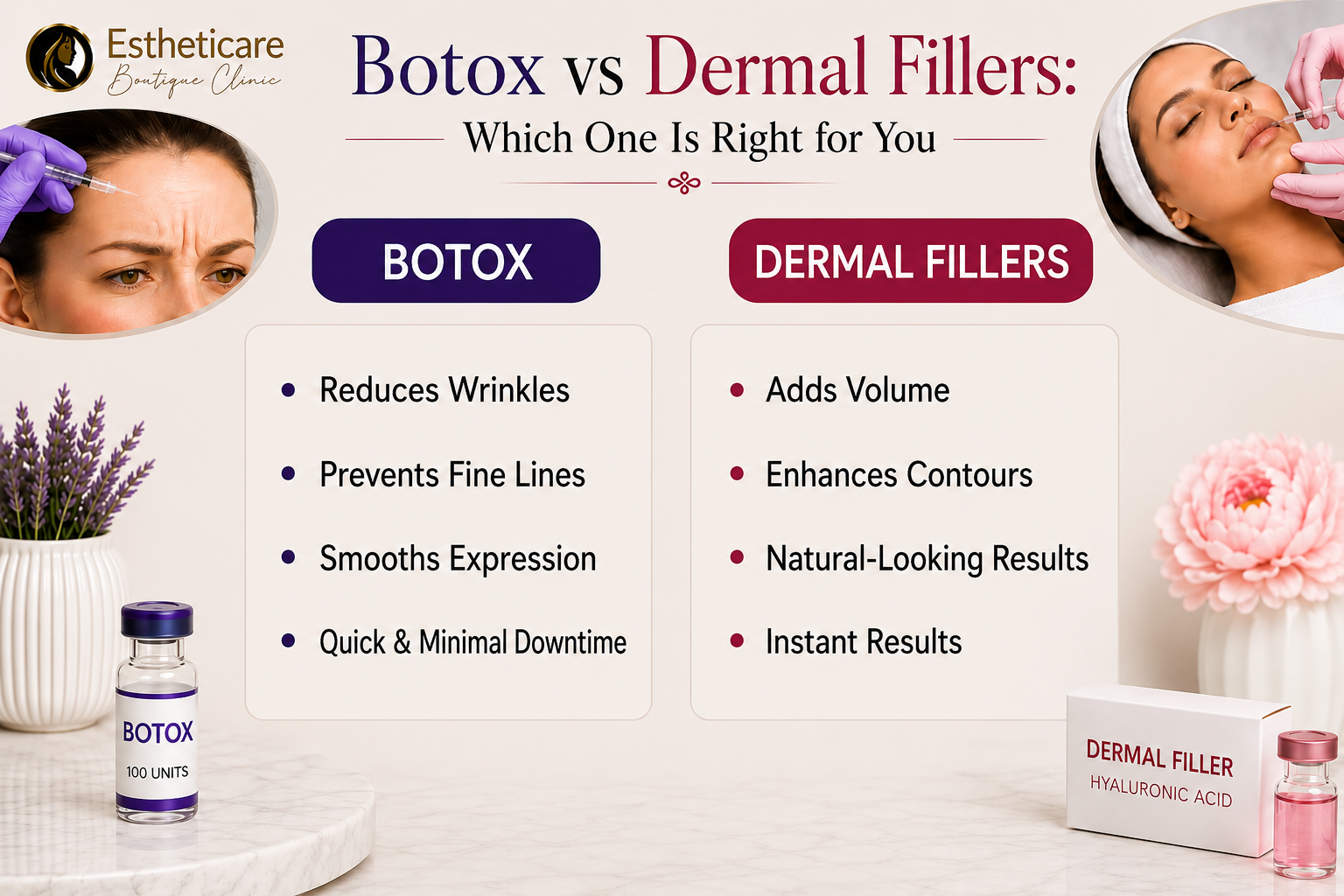
Botox and dermal fillers are the two most popular anti-aging injections, and people often mix them up. Both are quick, non-surgical, and can give you a fresher look, but they don’t do the same job. Botox relaxes the muscles that cause wrinkles. Fillers restore the volume your face has lost.
If you’ve been searching “Botox vs dermal fillers” trying to figure out which one you actually need, this guide breaks it down in plain terms, no jargon, just what each one does, what it costs in Islamabad, and how to know which is right for you.
Botox vs Dermal Fillers: The Quick Answer
Here’s the simplest way to think about it:
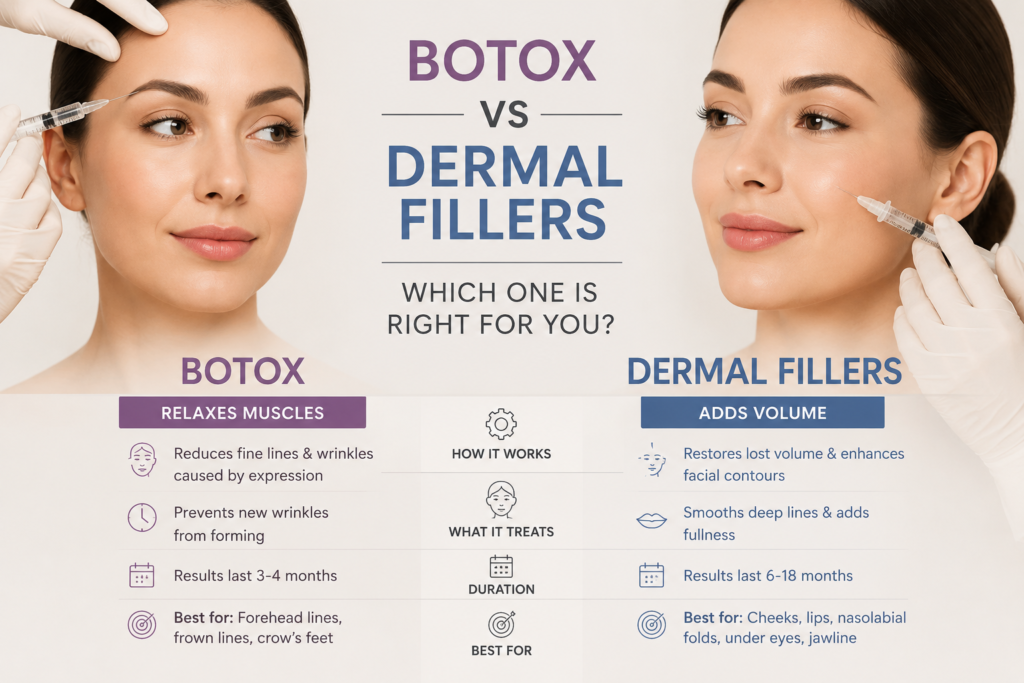
- Botox works on wrinkles caused by movement, like when you frown or squint. It blocks the nerve signals that make the muscle move, so the skin above it stays smooth.
- Dermal fillers work on volume loss, hollow cheeks, thin lips, and tired-looking under-eyes. They physically add fullness back into the skin.
So if a line only shows up when your face moves, that’s a Botox problem. If an area looks flat or sunken even when your face is completely relaxed, that’s a filler problem.
Botox vs Dermal Fillers: Side-by-Side Comparison
| Feature | Botox | Dermal Fillers |
|---|---|---|
| What it does | Relaxes muscles | Adds volume and shape |
| Best for | Wrinkles caused by movement | Volume loss, lips, cheeks, contouring |
| When results show | 3–5 days, full effect in 2 weeks | Immediately, final shape in 1–2 weeks |
| How long it lasts | 3–4 months | 6 months to 1 years |
| Pain level | Small pinches | Mild pressure or sting, often numbed |
| Reversible? | Wears off naturally | Hyaluronic acid fillers can be dissolved |
| Common side effects | Redness, light bruising, occasional headache | Swelling, bruising, rare lumps |
What Is Botox and How Does It Work?
Botox is a purified protein made from botulinum toxin. It sounds scary, but the amount used in cosmetic treatment is extremely small and well controlled; it’s actually one of the most studied treatments in aesthetic medicine.
Once injected into a muscle, Botox blocks the nerve signal telling that muscle to move. No movement, no crease. This is why it’s so effective on dynamic wrinkles, the lines that only appear when you make an expression, like frowning or raising your eyebrows, and disappear once your face is at rest.
Over time, if you keep making the same expression, that line can start showing up even when your face is still. That’s why a lot of people start Botox in their late 20s or early 30s, not to fix deep wrinkles, but to stop them from becoming permanent.
Where Botox Is Commonly Used
- Forehead lines are horizontal lines caused by raising the eyebrows.
- Frown lines between the eyebrows (also called “elevens”).
- Crow’s feet at the corners of the eyes.
- Bunny lines on the nose.
- Neck bands.
- Jaw slimming, for people who clench or grind their teeth.
- Medical uses like excessive sweating and migraines.
Not sure which of these applies to you? Visit Estheticare Clinic for Botox in Islamabad, and we’ll walk you through each area in more depth.
How Long Does It Take to Work, and How Long Does It Last?
Botox isn’t instant. It usually takes 3 to 5 days to start working, with the full result showing around the two-week mark. Once it kicks in, it typically lasts 3 to 4 months, depending on your muscle strength, metabolism, and how much product was used. Most people book a touch-up around month three, before the muscle fully wakes back up.
The Good and the Bad
Botox is fast, needs zero downtime, and looks completely natural when done properly. You’ll still be able to smile and raise your eyebrows afterward; you just won’t crease in the treated area.
What it can’t do is add volume. If your cheeks are hollow or your lips are thin, Botox won’t help at all. And if it’s injected badly or in too high a dose, it can leave you with that stiff, “frozen” look, which almost always comes down to the injector’s skill, not the treatment itself.
What Are Dermal Fillers and How Do They Work?
Where Botox relaxes muscles, dermal fillers physically restore volume under the skin. Most modern fillers are made from hyaluronic acid, a substance your body already makes to keep skin hydrated and plump. As you age, your natural supply drops, which is why cheeks lose fullness and lips get thinner over time.
Fillers put that lost volume back and can also add structure to areas that were never that full to begin with, like a flat chin or a soft jawline. Because hyaluronic acid pulls in water, it also helps the surrounding skin look more hydrated, which is part of why filler results can look so natural.
Types of Dermal Fillers
- Hyaluronic acid fillers (like Juvéderm, Restylane, and Teoxane) are the most common choice. They blend in naturally and work well on lips, cheeks, and smile lines. They’re also reversible; if you don’t like the result, it can be dissolved, and your face goes back to normal. That’s why most first-timers start here.
- Calcium hydroxylapatite (Radiesse) is thicker and longer-lasting, usually chosen for deeper wrinkles or building real structure into the jawline.
- Poly-L-lactic acid (Sculptra) works differently; instead of filling space right away, it triggers your body to make more of its own collagen over time. Results build gradually over a few months and can last up to two years.
How Long Does It Take to Work, and How Long Does It Last?
Unlike Botox, filler results are visible immediately. There’s usually some swelling for the first few days, so the final look settles in over one to two weeks. Depending on the type used and where it’s placed, results can last anywhere from 6 months to 2 years. Lips tend to fade faster since they’re always moving, while cheeks and jawlines hold their shape longer.
The Good and the Bad
Fillers are versatile; they can restore a tired, sunken look, sharpen your profile, or add shape to your lips, and you get to see the results the same day. Most fillers now come with a numbing agent mixed in, so it usually feels like pressure or a light sting rather than sharp pain.
The trade-off is that fillers carry a bit more risk than Botox. Bruising and swelling are common but temporary. There’s also a small chance of lumps, uneven results, or, rarely, filler affecting a blood vessel, which needs urgent attention. This is exactly why picking an experienced injector matters even more with filler than with Botox.
Can You Use Botox and Fillers Together?
Yes, and once people hit their early thirties, this is often exactly what’s recommended. Combining anti-wrinkle injections with filler treats both problems at the same time: Botox smooths the wrinkles caused by movement, while filler restores shape and volume where it’s been lost. Some clinics call this a liquid facelift when it’s done across multiple areas of the face.
Using both together doesn’t just cover more ground; it also tends to look more natural, since each treatment is doing the job it’s actually built for instead of one trying to do both.
How to Know Which One You Need
Ask yourself these questions before booking anything.
Noticing a Wrinkle Only When You Move
That’s a sign Botox is what you need. Forehead lines, frown lines, and crow’s feet all come from muscle movement; the skin creases when you make an expression and smooths back out once your face relaxes. Since Botox blocks the muscle signal, it stops that crease from forming in the first place.
Noticing an Area That Looks Flatter or Tired
If a part of your face looks sunken or tired even when you’re not making any expression, that’s a volume problem, not a wrinkle problem. This usually shows up as hollow cheeks, thinner lips, or a flatter jawline than you used to have. Botox won’t do anything here; only filler can put that lost volume back.
Looking for Something Less Permanent
If you’re new to injectables and not sure how you’ll feel about the results, Botox is the safer place to start. It wears off naturally within a few months, so if it’s not for you, you’re not stuck with it. Filler can also be dissolved if needed, but Botox fading on its own makes it the lower-commitment option for first-timers.
Thinking About Budget
Botox needs a touch-up every 3 to 4 months, so the cost adds up over the course of a year. Filler costs more per session upfront, but since it can last anywhere from 6 months to 2 years, you’re not paying as often. When you add it all up over a full year, the total cost for both treatments often ends up fairly close.
You don’t have to figure this out alone. A licensed injector who actually looks at how your face moves and where you’ve lost volume will give you a far better answer than any article can. You can browse our team of consultants to see who’s available before you book.
Is Botox or Filler Safer?
Both are safe when done by a properly trained, licensed professional using approved products. The real safety factor isn’t the treatment itself; it’s who’s holding the needle and how well they understand facial anatomy. Botox side effects tend to be mild — usually redness, light bruising, an occasional headache, or temporary weakness in nearby muscles. Filler carries a slightly higher, though still rare, risk if it’s injected too close to a blood vessel. Pick your injector based on skill, not price.
Who Shouldn’t Get Botox or Fillers?
Skip both treatments if you’re pregnant or breastfeeding, have an active skin infection near the treatment area, or have a known allergy to any ingredient in the product. If you have certain nerve or muscle conditions, avoid Botox specifically. And if you’ve ever had a serious allergic reaction to anything, mention it before your appointment; your practitioner needs the full picture to keep you safe.
Conclusion
There’s no real winner between Botox and dermal fillers; they just solve different problems. Want to smooth out movement-related wrinkles? Go with Botox. Want to bring back volume and fullness? Fillers are the better fit. A lot of patients end up doing both, either on separate visits or together, since that combination usually gives the most natural-looking result.
If you’re exploring dermal fillers in Islamabad or trying to decide between the two, come in for a consultation. Our dermatologists look at your face specifically, not a generic checklist.
FAQs
Which lasts longer: Botox or filler?
Filler usually lasts longer than Botox. Botox typically lasts between three and four months, while hyaluronic acid fillers may last anywhere from six months to a year; longer-duration, thicker fillers such as Radiesse or Sculptra may take up to two years to completely wear off.
Does the filler hurt more than Botox?
Neither one is overly painful or causes much discomfort. Botox feels mainly like a series of quick pinches while fillers create a feeling of mild pressure or a light sting. However, today’s fillers come equipped with numbing agents added in for pain-free treatment.
Can I combine Botox and fillers during the same procedure?
Yes! Many clinics conduct both services for their clients in one visit, which is completely safe. In fact, it’s not uncommon to see patients receiving Botox on the forehead with fillers on the cheeks and lips during one visit.
What happens when a person quits using Botox or filler?
Nothing serious happens if a person stops getting either treatment. Their face simply returns to its original appearance over time. Additionally, there is no so-called rebound effect, which means people won’t get worse from stopping.
Is Botox or filler better for under-eye bags?
It depends on what’s causing them. If the area looks hollow because of lost volume, filler (called tear trough filler) usually works better. But if the bags are actually puffy, caused by fat pads pushing forward, neither Botox nor filler will fix that; it usually needs a minor surgical procedure instead. Botox isn’t used here at all since it’s not a wrinkle caused by movement.
How much do Botox and fillers cost in Islamabad?
Botox at Estheticare Clinic starts from around PKR 7,000 for smaller areas like bunny lines, up to PKR 65,000+ for full-face or combination treatments, depending on how many areas and how many units you need. Filler pricing depends on the brand and how many syringes your treatment needs, and it’s usually quoted per syringe rather than per area.
Can Botox or filler go wrong?
It’s uncommon, but it can happen, especially with filler if it’s injected too close to a blood vessel. This is exactly why choosing someone qualified and experienced matters so much more than choosing the cheapest option. At Estheticare, all injectable treatments are carried out by trained dermatologists and aesthetic physicians, not technicians.