

September 5, 2026
Two needles, two completely different jobs. One slowly rebuilds your skin from within, over several months. The other fills in a hollow area the moment it is injected. Using the wrong needle for the job guarantees disappointment, not because the product failed, but because it was given the wrong task.
Sculptra and dermal fillers are both used to treat sagging cheeks, hollow temples, and deep lines, but they work in very different ways. This guide explains how each one works, which one lasts longer, which areas they are used on, and how to figure out which one is right for you.
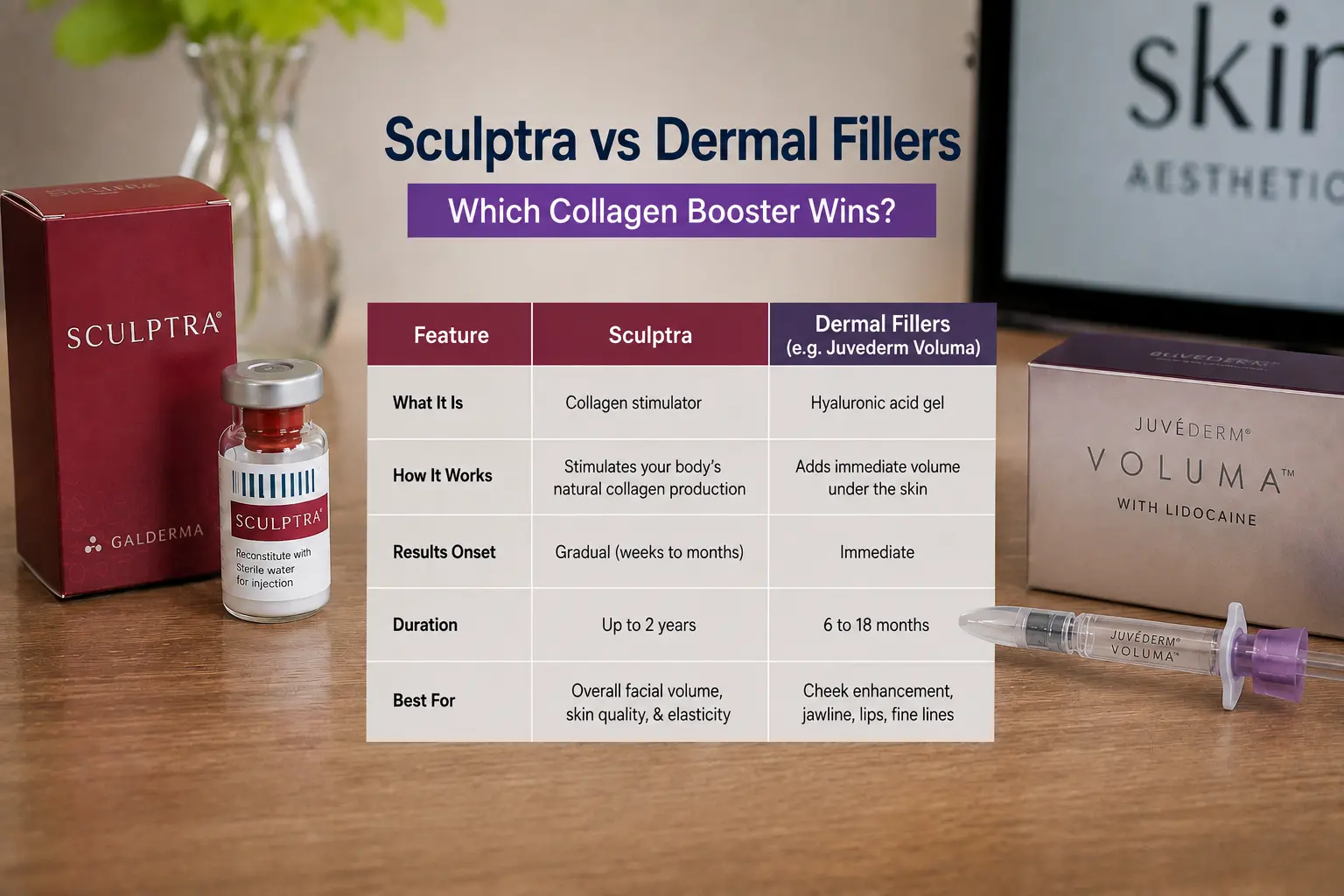
Sculptra vs Dermal Fillers
| Sculptra | Dermal Fillers | |
|---|---|---|
| What it’s made of | Poly-L-lactic acid (a safe, man-made substance) | Hyaluronic acid (a substance your skin already makes) |
| How it works | Helps your skin make its own new collagen | Adds volume directly under the skin |
| When you see results | Slowly, over 4 to 6 weeks | Right away |
| How long it lasts | Up to 2 years or more | 6 to 18 months |
| Sessions needed | 2 to 4, a few weeks apart | Usually just 1 per area |
| Can it be removed | No | Yes, it can be dissolved |
| Best used for | Overall thinning in the cheeks and temples | Specific spots like lips, under-eyes, and folds |
What is Sculptra
Sculptra is an injectable treatment that has been safely used in medicine for many years. Instead of simply filling in a hollow spot, it works with your body to help rebuild the collagen your skin has lost over time.
How Does it Work?
Sculptra comes as a powder that gets mixed with sterile water before it is injected. Once it is placed under your skin, it gently signals your skin to start making new collagen on its own, the protein that keeps skin firm and full. Over the next several weeks, your skin builds this new collagen while the original substance slowly disappears from your body. Because this is a natural process, the results do not show up overnight. They build gradually as your skin does the work.
Benefits of Sculptra
The biggest advantage of Sculptra is how natural it looks, since the improvement comes from your own skin rather than an added substance sitting underneath it. It also tends to last much longer than most fillers, which means fewer repeat visits, and works especially well if your face has thinned out all over rather than in just one spot.
Areas treated with Sculptra
Sculptra is mostly used on the cheeks, temples, and other areas where the whole face has lost volume. It is usually not used on the lips or right under the eyes, where a gentler, faster-acting option works better.
What are Dermal Fillers
Dermal fillers are gel-based injections, most often made from hyaluronic acid, a substance your skin already produces to stay hydrated and plump. Unlike Sculptra, fillers add volume immediately.
How Does It Work?
Once injected, the gel physically fills the space under your skin, smoothing out lines and adding volume right away. The gel is specially made to last longer than the hyaluronic acid your body naturally produces, though your body does slowly break it down over time. Some fillers are firmer, and some are softer, so an experienced injector chooses the right type based on where it’s used, since what works well in the cheeks might look too stiff in the lips.
Benefits of Dermal Fillers
The biggest advantage of dermal fillers is that you can see the result the same day, which is great if you have an event coming up or simply don’t want to wait. They also let your injector shape one specific area precisely, and if you’re ever unhappy with the result, it can be dissolved and corrected.
Areas treated with Dermal Fillers
Fillers are commonly used on the lips, under-eyes, smile lines, cheeks, and jawline, basically anywhere you want a specific, targeted change.
Which Gives More Natural Results?
Sculptra tends to look more natural because the volume comes from your own collagen, not an added substance. Since the change builds up slowly over months, nobody notices a sudden difference, which is why a lot of people choose it when they want to look better without looking like they have “had something done.”
Dermal fillers can also look very natural, but the result depends a lot on the product used and the skill of your doctor. Overfilling an area, or using too firm a filler somewhere delicate like the lips, is usually what causes that stiff or puffy look, not the filler itself.
Sculptra vs Fillers: Which Lasts Longer?
Sculptra generally lasts longer. Because the results come from collagen your own body built, they can last for up to two years or more. Most dermal fillers last somewhere between six and eighteen months, and areas that move a lot, like the lips, tend to wear off faster than areas that stay still, like the cheeks.
Which Is Better for Facial Ageing?
If your whole face has started looking thinner or less firm with age, Sculptra is usually the better option, since it tackles the root cause, which is a loss of collagen, rather than just adding volume in one place. If your ageing shows up more in specific spots, like deeper smile lines or thinner lips, a targeted filler often makes more sense. Many people dealing with several signs of ageing at once actually get the best results by using both together.
Can You Combine Sculptra and Dermal Fillers?
Yes, and many experienced doctors actually suggest doing this. Sculptra is used first to rebuild overall volume and structure over a few months, and then small amounts of dermal filler are added on top to fine-tune specific spots, like the top of the cheekbone or a stubborn line. The two treatments don’t compete with each other. They simply solve different parts of the same problem.
Treatment Process of Both Treatments
Consultation with our Doctor
Every treatment starts with a simple check-up of your skin and a conversation about what you want to achieve. Your doctor will look at where you’ve lost volume or noticed ageing and recommend Sculptra, dermal fillers, or a mix of both, depending on what suits your face. You can look through our team of doctors to find the right specialist.
Treatment
Sculptra is injected with a fine needle, spread evenly across the treatment area, usually across a few sessions spaced weeks apart. Dermal fillers are usually done in a single visit, with your consultant shaping the area as they go, since you can see the result immediately.
Aftercare (Guided by our Specialist)
After Sculptra, you’ll usually be asked to gently massage the treated area for a few days, which helps the product spread evenly and lowers the chance of lumps forming. After dermal fillers, aftercare is simpler, mainly avoiding pressing on the area too much while any swelling goes down. Your specialist will explain the exact aftercare steps for your specific treatment before you leave the clinic.
Are Sculptra and Dermal Fillers Safe?
Both treatments are considered safe when done by an experienced doctor, and both can cause mild, temporary side effects like swelling, bruising, redness, or tenderness, which usually clear up within a few days.
Dermal fillers have one extra safety benefit: they can be dissolved. If a result doesn’t turn out the way you hoped, your injector can reverse it and try again. Sculptra carries a small risk of tiny lumps forming under the skin, usually because the product wasn’t spread evenly during injection. This is why the aftercare massage matters, and why Sculptra can’t be reversed once it starts working. In both cases, choosing an experienced, well-trained doctor is the biggest factor in avoiding problems.
Sculptra vs Dermal Fillers Cost Comparison
Sculptra usually costs more upfront than a single filler session, since it is done as a series of appointments rather than one visit. But because the results last so much longer, the overall cost over a couple of years can end up fairly similar to repeatedly topping up filler every year or so. Dermal fillers cost less per visit but need to be repeated more often to keep the results looking fresh. Which one works out better for you really depends on whether you’d rather pay more upfront for longer-lasting results, or spread smaller payments across more frequent visits. A consultation is the best way to get a clear plan and estimate based on your own goals. Book a consultation to get started.
FAQ’s
What is the main difference between Sculptra and dermal fillers?
Sculptra helps your skin build its own new collagen over time. Dermal fillers add volume right away using a gel. One works slowly with your body; the other gives you an instant change.
Why does Sculptra take so long to show results?
It works by helping your body build new collagen on its own, which is not instant. Most people start noticing a difference around four to six weeks after treatment.
Can Sculptra be dissolved if something goes wrong?
No. Unlike dermal fillers, Sculptra can not be reversed, which is why it’s especially important to choose an experienced injector.
How many Sculptra sessions will I need?
Most people need two to four sessions, spaced a few weeks apart, with your doctor checking your progress at each visit.
Can Sculptra and dermal fillers be used together?
Yes. Sculptra rebuilds overall volume, while filler handles small, precise touch-ups in specific spots.
Is Sculptra suitable for the lips or under-eyes?
Usually not. These delicate, thin areas are better suited to a soft dermal filler instead.
Who shouldn’t get Sculptra or dermal fillers?
People with active skin infections, autoimmune conditions, a history of raised scarring, or known allergies to the ingredients are usually advised against both treatments. They are also not recommended during pregnancy or breastfeeding. A quick consultation with a qualified doctor is the best way to check if you’re a good fit.